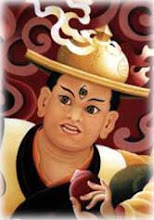
The Dalai Lama has banned the practice of Dorje Shugden, but on what authority?
Since the time of the Fifth Dalai Lama, the position of Dalai Lama has most definitely been a political one. No one would dispute that the Dalai Lama is the political leader of Tibet and head of the Tibetan Government in Exile, but what of his religious authority? Does he have the right and authority to ban the practice of a religious deity, as he has with Dorje Shugden, or to endorse a candidate to be the next Karmarpa thereby causing a schism in the Kagyu tradition?
The Dalai Lama is not the head of any of the four traditions of Tibetan Buddhism – the Nyingmas, Kagyus, Sakyas and Gelugpas. Each sect of Tibetan Buddhism has its own head. Many people mistakenly think that the Dalai Lama is the head of Tibetan Buddhism, or at least of the Gelugpa school, but if he is not head of any of the individual schools of Tibetan Buddhism, how can he be head of the whole Tradition? There is no 'Pope' of Tibetan Buddhism.
The confusion about the Dalai Lama's religious authority lies in the fact that he is a politician who is also a monk. When the Dalai Lama speaks, is it a politician who is speaking or is it a spiritual leader? No-one is quite sure, but clearly it can't be both because the aims of politics and religion are opposite and contradictory. It's not safe for a monk to do the job of politician unless the monk is stronger than the politician. If not, the monk becomes a politician who abuses religion for worldly goals rather than a religious leader who uses power and influence to accomplish spiritual goals.
Unfortunately, in the case of the Dalai Lama, it appears that the politician is uppermost. His actions are causing suffering to millions of Buddhists of the Tibetan lineage. There is one main reason why the Dalai Lama has banned the practice of Dorje Shugden; because it is politically advantageous for him to do so. He is playing the dangerous game of using religion to serve politics. His 'religious' reasons for banning this Deity are a smoke screen that hide a political agenda. Since 1961 the Dalai Lama has had the wish to unite all the schools of Tibetan Buddhism under his leadership. In an open letter to the Dalai Lama in 2001, the International Karma Kagyu Organization wrote:
In 1961 the Tibetan government in exile proposed to merge the four Tibetan schools into one religious body headed by Your Holiness. This policy inflicted serious spiritual suffering on much of the Tibetan exile community. Rallying behind Karmapa's authority, thirteen Tibetan settlements challenged the Exile Government's plan and as a consequence the whole scheme was abandoned. Later in the seventies Karmapa came under blame because he had chosen to defend the autonomy of the three other lineages.
"This policy inflicted serious spiritual suffering on much of the Tibetan exile community". This is also true for the Dorje Shugden ban. The scheme to merge the schools together may have seemed to be abandoned but His Holiness has not changed his ambitions; he still wants to be the supreme spiritual head of Tibetan Buddhism. To this end he has split the Kagyu tradition in the Karmapa controversy and has also split the Gelugpa tradition over the issue of Dorje Shugden.
Frighteningly, he is supported by most Tibetans and many Westerners in these actions who argue that 'Tibetans must be united at this time in order to achieve a free or autonomous Tibet'. If it is generally felt that Tibetans must be united, the Dalai Lama can justify the removal of anything that he feels might divide them, such as different religious practices and traditions. When the Dalai Lama does this he claims that these practices are 'sectarian'. There doesn't have to be anything wrong with 'sectarian'; that which is sectarian is that which is characteristic of a sect. A sect is simply a religious denomination.
Difference is not normally a problem. It's only a problem if differences are used to stir up disharmony, as the Dalai Lama has by demonising practitioners of Dorje Shugden. Different sects of Buddhism can engage in different practices but still respect each other. Why can't Dorje Shugden practitioners live happily side by side with those who do not practise Dorje Shugden? This was the case before the Dalai Lama spoke out against the Protector and linked the practice to such emotive subjects as his health and the cause of Tibetan independence. In this way, he made a harmless practice that gives great spiritual benefit into a threat.
In these spiritually degenerate times, religion is serving the needs of politics. Unfortunately, the Dalai Lama's fame and charisma is so great that no one questions his actions. Buddhadharma is either being destroyed due to attachment to Tibetan nationality or because the Dalai Lama wants supreme power – not just political but also religious, and is operating a 'divide and rule' policy. Either way, Buddhadharma is being destroyed; this will be the ugly result of the Dalai Lama's actions.
What gives him the authority to make pronouncements about someone else's spiritual practice? It is normal in Buddhism to follow the views, intentions and practices of a respected Spiritual Teacher, but the Dalai Lama has proclaimed his tutor Trijang Rinpoche 'wrong' for promoting the practice of the Wisdom Buddha Dorje Shugden. In doing so he has cast doubt on the whole Gelug lineage and is now operating autonomously without any legitimate spiritual authority.
By instigating a grossly biased 'referendum' on Shugden and having monks who refuse to give up the practice expelled from their monasteries he has caused a deep schism in the Gelugpa tradition. Who is questioning his actions? Who will stop him? Many Tibetans will accept anything he says because he is their leader and the great majority of Westerners are so blinded by his smiling visage in the media and his public image as a 'simple monk' and 'man of peace' that they will also go along with what he says. He can do no wrong.
The destruction of Buddha Shakyamuni's holy teachings through the distorted views and mistaken actions of the world's most charming and famous Buddhist is an intolerable situation. It's an 'inside job', but how is it that nobody has thought to ask "on whose authority is he doing this?" It is an indictment of our collective intellects in this age of celebrity, where style reigns over substance, that more people are not asking this question.
Posted courtesy of Lineageholder.
Tuesday, June 17, 2008
On what authority does the Dalai Lama do these things?
Sunday, June 15, 2008
Some questions answered
Television interview with WSS Spokesperson, Kelsang Lhachog
Nine MSN, June 15, Australia
Kelsang Lhachog, Australian nun, answers questions about what is happening in Tibetan society, the Dalai Lama's authority, why this problem cannot be ignored and more...
Saturday, June 14, 2008
ABC Radio National Interview with WSS Spokesperson
The Dalai Lama faces protests from within the Shugden Buddhist community on his Australian tour, 11th June 2008
Transcript
This week the Dalai Lama returns to Australia in fact for the second time in a little over a year. And as we go to air this morning, he's giving a press conference in Sydney.
Stephen Crittenden: That's a recent protest rally outside the Albert Hall in London.
The reasons behind these protests are either incredibly simple or incredibly complicated. The simple explanation is that for some years the Dalai Lama has been trying to eradicate the veneration of an obscure Tibetan deity called Dorje Shugden. Followers of Dorje Shugden say he's an emanation of the Buddha; the Dalai Lama says he is an evil spirit.
But there's also a more complex explanation. For years, the Dalai Lama has been attempting to unite the main strands or lineages of Tibetan Buddhism under his spiritual authority. But he's running up against fundamentalist groups even within his own Gelugpa strand, many of them Western Buddhists. And as he's tried to exclude the practice of praying to Dorje Shugden, Dorje Shugden seems to have become more and more central to their practice.
They say the Dalai Lama is a hypocrite who campaigns for human rights in Tibet but persecutes his own people, and that monks and nuns have been forbidden to follow Dorje Shugden and when they resist they have been ejected from monasteries.
So who or what is Dorje Shugden, and who are these saffron-clad protestors? Kelsang Pema is a spokesman for the Western Shugden Society. She's a British Buddhist nun who has been a prominent figure in protest rallies in the UK and she's just flown into Sydney.
Kelsang Pema: Dorje Shugden is a Buddha from the Buddhist tradition. He's a deity who has been prayed to and whose teachings have been followed for up to 400 years. The Dalai Lama himself practiced this prayer and the teachings until the 1970s when he had either a change of faith or a change of heart. And he himself personally decided not to follow this any more. It's a very simple practice which Buddhist people follow in order to develop pure minds of love, compassion, wisdom and spiritual protection.
Now the Dalai Lama has had a change of faith and not being satisfied with his own change of faith he decided to inflict this upon the Buddhist community in general internationally, and this is the problem that we face at the moment, because he is saying that people who follow this deity, Dorje Shugden, are no longer Buddhist.
Stephen Crittenden: Why is he opposed to it? My understanding is that this is a fairly unusual practice, is that right?
Kelsang Pema: I would say it's definitely not an unusual practice, it's 400 years old.
Stephen Crittenden: That's a pretty short length of time in Buddhist terms I suppose.
Kelsang Pema: No, not when you consider that the new tradition the Dalai Lama himself created is only about 15 years old.
Stephen Crittenden: Am I right in thinking that Dorje Shugden is a somewhat malevolent emanation of the Buddha?
Kelsang Pema: Oh, absolutely not, no. He's a protector, and protector from the point of view of as I say his purpose is simply to encourage people to develop pure minds of love, compassion, wisdom and spiritual protection, they're not malevolent, the practice is not harmful and it cannot have any harmful effects, because that would be complete contradiction to the nature of the practice.
Stephen Crittenden: As it's been explained to me, the background to this story is that the Dalai Lama over many years now, has been trying to unify all the major strands of Tibetan Buddhism, and that your group is really resisting his spiritual authority, and that the Dalai Lama has run up against the cult of Dorje Shugden. It's a practice that he sees as an obstacle in the path to this greater unification of the various strands that he's trying to bring about.
Kelsang Pema: Not entirely correct, one because Dorje Shugden practice is not cultic; second, he's not running up against us, he himself is causing division within the British community because his two reasons that he's publicly given for abandoning these practices. 1) it causes his lifespan to shorten; and 2) it interferes with Tibetan independence. Well the guy is 72 years old, so it's obviously not very harmful to his life span, and it actually has no ability to harm anybody's lifespan, let alone the Dalai Lama's and second, he's publicly said many times recently, that he's not interested in Tibetan independence. So if they're the two valid reasons he's given, then there's no valid reason left for abandoning the practice.
Stephen Crittenden: But is it true that your group is a rejectionist group within the Gelugpa tradition, a movement that rejects the spiritual authority of the Dalai Lama?
Kelsang Pema: No, that's not correct, because if the Dalai Lama would just allow people to have religious freedom, they'd be very happy to accept him. I think one gross misunderstanding in the West is that the Dalai Lama is perceived to be the Buddhist leader per se. He's not. If you got to Burma, Sri Lanka and so forth, ask those Buddhists who's their Buddhist leader, definitely they would not say the Dalai Lama, and even within Tibet, Tibetan Buddhism, the position of Dalai Lama has never had authority over the other three schools of Tibetan Buddhism. Only now in this century, during the time of this 14th Dalai Lama has such a proposed unification been proposed.
Stephen Crittenden: That's why I raised the question. I mean what the Dalai Lama's project has been over recent decades, he's been trying to unify all the major strands of Tibetan Buddhism under his authority, that's correct, isn't it?
Kelsang Pema: According to him, yes. But if you check with each of the other schools, actually this is not correct, because each of the other three schools also are fighting an internal turmoil because the Dalai Lama is cutting of limbs of those branches also. The Karmapas, for example, they've been paralysed for many years because the Dalai Lama is interfering with their tradition. In the same way he's now trying to reorganize the Gelugpa school.
Stephen Crittenden: So this is as much to do with the authority of the Dalai Lama as it is to do with a simple prayer?
Kelsang Pema: I think the two become mixed because of the Dalai Lama's own agenda. As we all know, he has two hats, he has his political and he has his religious, and it definitely seems that he's using both hats to accomplish one aim, and this is where a lot of the problems are stemming from.
Stephen Crittenden: How many Buddhists around the world follow Dorje Shugden?
Kelsang Pema: There are actually millions of them internationally, and even within Tibet alone, over one-third of the population relied upon the practice of Dorje Shugden.
Stephen Crittenden: But your group, if I'm correct, your group has grown up in the West. Are you part of the New Kadampa tradition?
Kelsang Pema: No, we're the Western Shugden Society.
Stephen Crittenden: Right, and they're separate groups?
Kelsang Pema: They're completely separate, the New Kadampa tradition is a registered company and charity, the Western Shugden Society is simply a group of Dorje Shugden practitioners who come together to be heard by the Dalai Lama, because for 20 years individual practitioners have been writing letters requesting audiences, sending faxes to the Dalai Lama requesting him to explain his position and to basically allow religious freedom to prevail within the Buddhist community, and he's not even acknowledged such requests. So therefore we've decided together to unify and with one voice ask him.
Stephen Crittenden: Right. I have to say I've read your letter on your website. It's a pretty tough, strident letter. It's really a letter of demand, I'm not surprised he hasn't answered it.
Kelsang Pema: Well considering we've sent countless letters and petitions over the course of 20 years, we have no choice, we were forced into a corner, you know, especially when in January he initiated a referendum which basically if you follow his view, you receive an identity card, which is your passport to human freedom within the Tibetan in Exile community. Without it, and that means if you continue to practice Dorje Shugden you're a victim to any number of atrocities.
Stephen Crittenden: You're following him wherever he goes around the world on his travels, protesting. And this will be the first big protest of this kind in Australia.
Kelsang Pema: Correct. We started in America in April. We were in Germany with three demonstrations and three recently in the UK, and now we have them in Australia.
Stephen Crittenden: And will these be peaceful protests?
Kelsang Pema: Absolutely. We have completely pure intention and motivation and our intention is simply to protect one pure ancient lineage from being destroyed without valid reason and our motivation is compassion. So there's no anger, there's no hostility. We're just looking for a peaceful resolution. Of course we make noise, but without noise we're not heard, and that's been proved over 20 years through the correspondence that he's ignored.
Stephen Crittenden: Pema, given the political situation that the Dalai Lama is dealing with at present with the Chinese and the Tibetan situation, I have to ask you the question that most Australians are sure to be asking: are you agents of the Chinese Communist Party or are you their dupes?
Kelsang Pema: Absolutely not. You can check me out, do whatever you like, I've got no connections with the Chinese at all, and I have to say to you that this is just again the propaganda of the Dalai Lama's camp because there's no valid reason for claiming that.
Stephen Crittenden: But surely it's nothing to do with propaganda to make the point that your protest at this extremely inauspicious time, can only, surely it can only, undermine the Dalai Lama's authority and weaken the situation of the Tibetan people. The Chinese must be laughing their heads off.
Kelsang Pema: I don't know what the Chinese are doing but I wouldn't say this is inauspicious when I'm witnessing people being denied medicine, people being denied education, being ostracised from their homes, being vicitmised and threatened simply because they want to maintain this prayer. They don't want to encourage other people to practice it, they just simply want to get on with their own spiritual life, and that's happening because of the Dalai Lama initiating, endorsing, and proactively campaigning for the abolishing of this practice.
Stephen Crittenden: Where is this persecution that you're alleging? Where is it happening?
Kelsang Pema: It's happening right now as I speak in India, and even last week in Paris, the Dalai Lama's own sister was travelling around encouraging people to abandon this practice, and in America also.
Stephen Crittenden: Is it true that the Panchen Lama, the fake Panchen Lama, the Chinese Panchen Lama has got himself mixed up in this controversy? I know he's been photographed in front of an image of the Dorje Shugden?
Kelsang Pema: I don't feel I'm in a position to comment because I don't know much about that situation.
Stephen Crittenden: That's Kelsang Pema, who's a spokesman for the Western Shugden Society.
Friday, June 13, 2008
Trijang Rinpoche is very clear on this subject

From Music Delighting the Ocean Of Protectors
by Kyabje Trijang Dorjechang
Root Guru of most Gelugpa Lamas alive today, including the Dalai Lama, who relied upon Dorje Shugden as his Protector until his death
"Some, who have fallen under the influence of the demon of the partisanship, think and say that this supreme Deity, the great emanated Dharmapala, is no different than an ordinary gyalpo or tsen spirit who has an inferior form as a result of being a monk or lay person who died with bad karma. Leave aside relying upon him as a Protector, they even deride others who do so. There are some, indeed, who echo such claims knowing nothing about it.
"Yet all this talk is nothing but babbling speculation. Why? Because this great guardian of the teachings is well known to be the precious supreme emanation from Drepung monastery'supper house, Dragpa Gyaltsen, arising in a wrathful aspect. The proof is unmistaken. Tulku Dragpa Gyaltsen, as is taught in the lineage, was the final birth in a reincarnation lineage that included the Mahasiddha Birwawa, the great Kashmiri Pandit Shakya Shri, the omniscient Buton, Duldzin Dragpa Gyaltsen, Panchen Sonam Dragpa, and so forth; this is proven by valid scriptural quotation and reasoning. These great beings, from a definitive point of view, were already fully enlightened, and even to common appearances, every one of them was a holy being that attained high states of realization. What worse karma could there be than denying this and asserting that he was born in the preta (spirit) realm?
'Therefore, for holy beings it is not at all far-fetched that they might show themselves in a wrathful form out of the power of compassion and prayer for the sake of a special purpose, and it should be recognized that they are emanations of Buddha's inconceivable secret qualities. But for them to take birth as a sky-wandering preta through the force of negative throwing karma like an ordinary preta would be utterly impossible. To say it were possible would be to deny the validity of the natural law of cause and effect. Why? From the definitive point of view those holy beings are fully enlightened. Moreover, even from the common point of view they attained high states of realization in reliance upon guarding their moral disciplines as they would their eyes, from youth onwards throughout their lives. To say that a causal factor of pure ethical discipline could result in rebirth in a lower realm of existence would be to assert that actions performed could be wasted; that one could experience the results of actions not performed by oneself; and that such scriptural statements as "From generosity, wealth, from ethics, happiness, are invalid and so forth. As a consequence, one would be turning ones back on Buddha's teachings as a whole.
"Furthermore, from the definitive point of view, that these holy beings were already fully enlightened innumerable ages ago, is clear if one examines the accounts of their lives, and if one were to say that a fully enlightened being could take birth as an ordinary gyalpo or tsen spirit, then one would be asserting that degeneration is possible from the state of full enlightenment or that someone could be both fully enlightened and an ordinary preta at the same time! Or else, one would have to say that the accounts of those great beings lives are worthless. A mountain of absurd consequences, previously non-existent distorted ideas, would have to be accepted."
See the complete text of Music Delighting the Ocean Of Protectors in English or Tibetan.
Wednesday, June 11, 2008
Is the WSS the NKT in disguise?
Whenever the Western Shugden Society (WSS) demonstrate, there always seem to be a few individuals waiting to jump on the blogs to insist that the WSS is the New Kadampa Tradition (NKT).
This theory is incorrect.
As it says on the Western Shugden Society website (translated into 9 languages):
“The Western Shugden Society (WSS) is an ad hoc coalition of Dorje Shugden practitioners from many different countries. The immediate aims of the WSS are expressed in a recent letter we sent to the Dalai Lama.”
The WSS includes many Tibetans, both in India and in countries in the West. For example, if you look at the WSS website, particularly at the news reports from the demonstration at Colgate University, you will see photos of some of these Tibetans in the West.
The Tibetans who are suffering under the Dalai Lama’s ban and subsequent ostracism and human rights abuses in India are of course not free to travel to demonstrate – they need identity cards to do anything and are not issued these if they are Dorje Shugden practitioners. The WSS is demonstrating on their behalf. At this point, the Dalai Lama cannot force Westerners to give up their practice of Dorje Shugden, although he has created a great deal of tension and bad feeling in Western Buddhist Centers through his actions.
As one Tibetan, Tenzin Gelek, said today in reply to a blogger (June 12 2008):
“Western Shugden society is coalition of Dorje Shugden practitioners around the world including Tibetan. It is not NKT group. We do share same lineage and teachers. As a Tibetan I am very grateful to all demonstrators for bringing helping us Tibetan, who are suffering, because of this ban. The suffering of Dorje Shugden practitioners in Tibetan Exile is true and real. Many westerners are misinformed by Dalai Lama and his publicity machine accusing Dorje Shugden practitioners as support by Chinese and devil worshipers or there is no real ban. Until 1996 we all lived in harmony in monasteries and Tibetan community. Dorje Shugden practitioners are suffering, monks are kick out of monasteries, children are ban from school and denied aid given by western aid group etc. We urge all freedom loving peoples of world to support our religious freedom and human rights. Thank you all.”
If you read the account of the demonstration given earlier on this blog, you will also get more of a feeling for who is in the WSS.
As for those who follow the New Kadampa Tradition, it is clear that many Kadampas are also Western Shugden Society supporters as they rely upon the practice of Wisdom Buddha Dorje Shugden. However, by no means all WSS supporters are NKT, not even a majority. There are potentially hundreds of thousands of WSS supporters worldwide and over the coming months (or years if needs be) they will engage in more and more activities to bring the Dalai Lama’s unlawful and unconstitutional actions to light. For example, check DorjeShugden.com for some other Western Shugden practitioners and ShugdenSociety.info for some of the Shugden practitioners in the exile community in India.
In May 2008, at the Spring Festival at Manjushri Kadampa Meditation Centre, Geshe Kelsang Gyatso (the Spiritual Director of the NKT) explained that he was supporting these demonstrations because the spiritual lives of Shugden practitioners throughout the world are in danger and he wants to help them.
This is the motivation of many of the people practicing in the New Kadampa Tradition. As one NKT practitioner expressed it: “For example, I am an NKT practitioner, but I am also individually and by choice (not by NKT policy) a supporter of the Western Shugden Society as I want to help restore the religious freedom of Shugden practitioners in India -- those are two different hats.”
If the demonstrations were organized by the NKT, there would have to be a decision taken by the NKT Board of Directors. But they have never met about the issue nor made such a decision.
Finally, it is worth noting that NKT practitioners are free to attend the demonstrations or not as they choose (and they do choose), as these have nothing to do with the NKT organization.
Check out these websites for other Western Shugden supporters in the West:
DorjeShugden.com
Dagom Gaden Tensung Ling
Sumati Arya
and in India:
ShugdenSociety.info
Mixed Aussie welcome for Dalai Lama
From Live News
The Dalai Lama has arrived in Australia to a warm welcome from supporters but was branded a "liar" and a "hypocrite" by some 50 protesting Buddhist monks and nuns.
Members of a Buddhist group known as the Western Shugden Society (WSS) accuse the Dalai Lama of suppressing religious freedom and driving them out of the Buddhist community.
They chanted "Dalai Lama stop lying" and waved placards calling for religious freedom when the exiled Tibetan spiritual leader held a meditation seminar at Sydney's Olympic Park.
"He is a hypocrite, and it's very sad to say that about a religious leader," said WSS spokesperson Kelsang Pema after the Dalai Lama flew into Sydney for a visit that includes talks with both the federal government and opposition.
"He is not practising what he preaches.
"He's here teaching about love and compassion but he endorses human atrocities, basically."
She said the Dalai Lama's "inflammatory" campaign against a Buddhist deity called Dorje Shugden had resulted in thousands of monks being expelled from monasteries, supporters denied food, medicine and travel visas, families being ostracised and Shugden temples being destroyed.
"It's mainstream Tibetan Buddhism, but he is making us look like an off-shoot because he has had a change of heart.
"He has banned a prayer which he himself engaged in for half of his life."
The protest was peaceful, so much so that the demonstrators took a morning tea break.
Can I help restore religious freedom?
Signing the Petition Let the Dalai Lama know that his behaviour on this issue is completely unacceptable, and petition him to stop intimidating Dorje Shugden practitioners and to allow them religious freedom.
Making Donations Donate towards Shugden practitioners, including the Dorje Shugden Devotees Charitable Trust in India who are helping to document the abuse and working to restore human rights. Please send an email to: dharma.protectors@gmail.org for information on how to make donations.
Prayers and dedications Please make prayers and dedications for the success of our campaign, the preservation of the tradition of Je Tsongkhapa, and peace and freedom for everyone in our world.
Tuesday, June 10, 2008
Dalai Lama arrives in Sydney
From The Sydney Morning Herald
He arrived in Sydney this morning.
Members of the Western Shugden Society, many of them Buddhist monks and nuns, were chanting "Dalai Lama, stop lying" and "Dalai Lama go away".
The society, which followed the Nobel Laureate across the United Kingdom and Germany, accused the Buddhist leader of suppressing their religious freedom and of being a religious dictator.
"The Dalai Lama has come to Australia to talk about love and compassion but he is not practising what he is preaching," a spokeswoman for the group, Kelsang Lhachog, said.
"In India, thousands of innocent monks have been expelled from their monasteries, supporters denied food and travel visas, families ostracised and temples destroyed because of this man.
"We must demonstrate because the Dalai Lama has refused to engage with us."
The protestors cries were met with jibes from a handful of those attending the event.
One audience member accused the protestors of being paid by the Chinese government.
Others attempted to shout over their cries.
"It's sad that these people have been sucked into supporting Djore Shugden,'' one Dalai Lama supporter, Karma Phunstok said.
"This is a peaceful man, they should not be protesting.''
Hundreds of Dalai Lama supporters were pouring into the Sydney Superdome past the protesters.
They were subjected to weapons searches with metal detectors before being allowed past the two metre-high steel security fence.
A member of the Sydney Tibetan Community, Lobsang Lungtok, said the protests were disrespectful to the Dalai Lama, who was simply in Sydney to lead five days of meditation teachings.
"It is their political right to protest but we will not engage with them," Mr Lungtok said.
"His Holiness has advised us not to face off with them and we will abide by his wishes."
The Shugden Society are worshippers of a Buddhist deity known as Dorje Shugden, who has been denounced by the Dalai Lama as a heretic.
This has led to a bitter division between the two groups, with members of the Shugden society claiming that they have been ostracised in Tibet and across the West.
Now is the time
Should we demonstrate? Are we rocking the boat? Are we wrong to call the Dalai Lama into question? Are we betraying Tibetans and tarnishing the reputation of Buddhism itself? These and other questions are discussed below.
The Western Shugden Society demonstrations have met with objections from Tibetans who believe that criticism of the Dalai Lama has an adverse effect on the cause of Tibetan independence and unity. They complain that it tarnishes the reputation of Tibetans worldwide as the Dalai Lama is their leader in the eyes of the world and their most recognizable symbol.
At the same time, some Western Buddhists and supporters of Tibetan independence have objected to the demonstrations on the grounds that these damage the reputation of Tibet or of Buddhism. It seems that we are spoiling their fantasy of Shangri-la.
These people say that we are wrong to protest publicly, to challenge the Dalai Lama's perceived authority, to "rock the boat", as it were. Some say we are wrong even to question the Dalai Lama and to oppose his edicts. Some say simply that, even if we disagree, we should do so privately, without bringing such shame down upon our house. They say that it is horrible to see monks and nuns on the streets shouting -- that this is un-Buddhist, that we appear angry, and that we should stop.
The critics are correct insofar as, without doubt, the current schism is having an adverse effect on the reputation of Buddhism worldwide, but they are wrong to say that we should be silent for the sake of temporary harmony and to save face. To do so would be like the family of an abusive father staying silent about the abuse for the sake of the family name. Effectively, we would enable and allow the Dalai Lama to continue to commit whatever abuses and atrocities he chose, unchecked.
Our house is not in order. All is not well. We cannot pretend that it is.
When the scandal of abusive priests within the Catholic church broke recently, the greatest shame and pain came from the cover-up that had occurred. What outraged people the most was that no-one within the church had spoken out to expose the abuse and stop it. It was this that was perceived to be the greatest deception and the most horrible betrayal of trust.
If we make ourselves accomplices to the Dalai Lama's present abuse of human rights by staying silent, then how will the world react when, as will definitely happen, the abuse finally comes to light? How will it affect the reputation of Buddhism and Buddhists throughout the world if no-one among us had dared stand up and blown the whistle: "Our house is not in order. This is not right."?
As sincere Buddhists, all Dorje Shugden practitioners must stand up and be counted. We have the responsibility to expose this decay in the highest levels of our community and to oppose it. If we do not do this, where is our honesty and our integrity – our decency? Who will trust us when the Dalai Lama's mask falls? If we say nothing, then we will be morally bankrupt, accomplices, and the Dharma will truly have been destroyed from within, as the Buddha predicted.
It is completely wrong to say that the Dalai Lama is beyond reproach because he is the Dalai Lama. Buddha Shakyamuni himself taught us that we must question and clarify the meaning of the Dharma that we hear and never blindly accept what any teacher says, however famous or charismatic they may be. Blind acceptance is not Buddhism: it is creating the conditions for dictatorship and fanaticism.
It is completely wrong to hide the faults within our house from the world, pretending that all is well while thousands, even millions, suffer as a result of one man's delusion. That is not loyalty; it is cowardice and deception.
We must fight this, however painful and embarrassing it may be for us: that is our responsibility as Bodhisattvas. No Buddhist wants to protest, or would choose to be seen waving their fists and shouting; but we have, literally, no choice. We did not create this situation; that responsibility lies solely with the Dalai Lama and his government in exile. He and he alone is responsible for this unprecedented schism in the Sangha. As Buddhists, the responsibility we do have is to bring this shame to light and to do what we can to control the damage. If we don't do this now then we make of ourselves cowards and accomplices.
Of course we feel deeply sorry for the Tibetan people and for all the Dalai Lama's faithful disciples: he is betraying them all. As sincere practitioners of Dorje Shugden we must not also betray them by staying silent. Keeping a patient mind within, we must fight this with truth and wisdom, with compassion and love. If we do so, we will definitely prevail and Je Tsongkhapa's tradition will remain for the benefit of future generations.
Now is not the time for Buddhists to sit there -- now is the time for them to stand up for what is right. Now is the time to dispel false accusations against the innocent. Now is the time to protect the pitiful and the protectorless.
If we do not take this challenging and brave step at this point in history, then an immensely profound and compassionate lineage of Buddhadharma is lost in our very lifetimes. This must not happen.
Published courtesy of Atisha's Cook
Monday, June 9, 2008
What about the WSS demonstrations?
Yesterday the Western Shugden Society held a demonstration at Colgate University in Hamilton, protesting the Dalai Lama's ban of Dorje Shugden and the persecution of followers of this Buddhist lineage of Je Tsongkhapa in the Tibetan exile community in India.There were over 200 Dorje Shugden practitioners from the West (from 10 countries altogether, but mainly the USA and Canada), and nearly 100 Tibetan monks, nuns, and lay people, including Geshes (doctors of divinity) and Rinpoches (reincarnate Lamas).
The police attending said they had never met such helpful, peaceful, and non-angry demonstrators. [ed: this is a comment that has been echoed by police in all subsequent demonstrations.]
Geshe Sopa said to me: "How can I deny the evidence of my own eyes? I know that Trijang Rinpoche practiced Dorje Shugden his whole life. How can I agree with the Dalai Lama and stop this practice, breaking my commitment to my own Spiritual Guide?"
The representative replied: "Of course, if this is really happening, it is wrong. I will investigate. Put it in writing. Tell me who is saying these things." Then a Tibetan woman called Heidi gave him a piece of paper that listed grievances. And many of the Tibetans animatedly started telling him one instance after another of abuse – all in Tibetan so I could not understand details [ed: it transpired later that the words they used were very respectful].
The representative was visibly taken aback. He tried to repeat: "There is no ban". He said he wanted the names of people who had experienced these grievances. Pema then asked him to explain why, if there was no ban, the day after she had spoken with the six monks in the monastery about the situation, they had each received death threats. The spokesperson said again: "If this happened, of course it is wrong. I will investigate." All this is on camera. He has promised to investigate all these instances of discrimination and abuse. Let's see if he does. [ed: no sign of him doing so yet].
The Dalai Lama never replied to any earlier letters sent to him giving him a deadline to stop expelling the monks from Sera Je Monastery (removing all their spiritual and material support, effectively outcasting them in their own exile community) or we would protest publicly, which is why the demonstrations are going ahead.
Sunday, June 8, 2008
Can this holy being and his predecessors and followers really all be spirit worshippers? You decide.
By saying that those practicing Dorje Shugden are spirit worshippers, the Dalai Lama is saying that his own root Guru, Trijang Rinpoche, was a spirit worshipper. But a quick look at Trijang Rinpoche’s biography shows that he was a holy and reliable Lama, that the Dharma of Je Tsongkhapa that he taught was beautiful and authentic, and that the disciples who follow faithfully in his lineage of relying on Dorje Shugden as the holy Protector of this Dharma are correct to do so, even if it means disobeying the political will of the Dalai Lama.
Kyabje Trjang Rinpoche (1900-1981) was a foremost Gelug Lama and a direct disciple of the great Je Phabongkhapa. He edited Pabongka Rinpoche's Liberation in the Palm of Your Hand – one of the most-studied Lamrim (stages of the path to enlightenment) texts in the Gelugpa lineage.
He served the fourteenth Dalai Lama first as philosophical assistant, then as personal tutor, together with Kyabje Ling Dorjechang (also a Dorje Shugden practitioner) for altogether fifty years. In this capacity, he taught the Dalai Lama from the elementary level up to the highest Tantric transmissions. He was the Ganden Tripa, the head of the Gelugpa School of Tibetan Buddhism to which the Dalai Lama belonged.
Up to the end of his life, Trijang Rinpoche continuously and widely taught the pure Dharma of Je Tsongkhapa’s tradition for the sake of all sentient beings. The growth of Dharma in the West is also directly and indirectly connected with him because of his own teachings as well as the activities of his disciples such as Kyabje Zong Rinpoche, Geshe Kelsang Gyatso, Geshe Rabten, Lama Yeshe, Lama Zopa, Tomo Geshe, Gonsar Rinpoche, Dagom Rinpoche, Geshe Tsultrim Gyeltsen, the Dalai Lama, and many more. Without him the situation of Tibetan Buddhism in the West would be completely different.
Trijang Rinpoche was also the backbone of the struggle against the Chinese occupation at the most difficult and confused time of Tibetan history (that is, until now). The escape of the Dalai Lama from Tibet in 1959 was also thanks to his wisdom and efforts. He is credited with writing Gyallu, the Tibetan National Anthem adopted by the community in exile, around 1950.
Trijang Rinpoche relied upon Dorje Shugden until the day of his death and (according to a heart disciple with him at the time) was “very disappointed” when the Dalai Lama told him he was giving up the practice. He wrote Music Delighting the Ocean of Protectors, a commentary to a praise of Dorje Shugden called Infinite Aeons by Je Pabongkhapa's own root Guru Dagpo Rinpoche.
Trijang Rinpoche is universally revered, respected and loved by Dorje Shugden practitioners and even by former disciples who have given up his lineage to follow the Dalai Lama. Tellingly, Lama Zopa, for example, has nothing bad to say about Trijang Rinpoche or even Dorje Shugden. It seems that he has given up this spiritual practice and obliged his disciples to do so simply out of political expediency.
Trijang Choktrul Rinpoche now lives as a private citizen in America so as not to come under the control of the Dalai Lama.
Read also Kuten Lama’s (a Dorje Shugden oracle) biography to see how far-spread the reliance upon Dorje Shugden was amongst the greatest Gelug Lamas of the last century.
Saturday, June 7, 2008
Double standards apply
The Dalai Lama is doing everything he is accusing everyone else of. For example:
1. The Dalai Lama claims that Buddhism is degenerating into spirit worship by relying on Dorje Shugden, yet he propitiates (and has a whole temple for) a spirit claiming to be Nechung whom he relies on for advice.
2. The Dalai Lama accuses the Chinese of abusing the human rights of Tibetans, yet he is abusing the human rights of Dorje Shugden practitioners worldwide.
3. The Dalai Lama is accusing Dorje Shugden practice of being 'sectarian', even though he is being sectarian by banning the practice that was done by his holy Teachers whom he says are 'wrong'.
4. He says that Dorje Shugden practice is causing problems in Tibetan society, but all such problems exist only because of the Dalai Lama's actions of demonizing practitioners of this Deity, stiring up disharmony and causing divisions where no such divisions existed before by exploiting the issues of his health and the cause of Tibetan independence, which he has no intention of achieving anyway.
5. He says that Dorje Shugden practice is divisive, but he has divided the Sangha, something that has never happened before in the history of Buddhism on this scale. Geshe Sopa said recently when he attended the demonstration in Oxford that what the Dalai Lama has done is worse than what the Chinese did, because the Chinese could not divide the monks, but the Dalai Lama has managed to do so. (http://www.westernshugdensociet
6. He is trying to enforce his ban of Dorje Shugden in Tibetan society, and in Buddhist society in general, saying that people are not listening to him; when he has refused for over ten years to listen to the petitions of Western Shugden practitioners who simply want religious freedom for all.
There can surely be no greater example of the ugly results of mixing religion and politics than the Dalai Lama's present actions of destroying a pure spiritual tradition.
Posted courtesy of Lineageholder
Calm before the storm
The Dalai Lama himself joked about their international protests: "Where I go, they go, different places where I go, so I think they enjoy."
The Dalai Lama will be Teaching in Sydney, Australia from June 11 to 15.
Friday, June 6, 2008
Buddhists speak out against the Dalai Lama
Article in British Asian News
Gordon Brown is making a terrible mistake. The Dalai Lama has been invited to speak before a committee of MPs on 22nd May 2008 to give evidence about human rights abuses in Tibet.
However, the Dalai Lama himself, Nobel Peace Prize winner and supposed champion of human rights, is busy at work forcefully and unlawfully removing innocent Buddhist practitioners from the Buddhist community under the smoke screen of the Olympic Torch Demonstrations. In a world where the Western and American ideal is a separation of politics and religion to prevent abuses of power, the Dalai Lama is the very embodiment of the union of politics and religion, with dire consequences.
Right now he is forcefully and unlawfully removing Tibetan Shugden worshippers from the Buddhist community, saying that the Shugden worshippers are not Buddhists because they are worshipping a Deity called Shugden who he alleges causes his life span to shorten and interferes with Tibetan independence. At the same time, he is preparing to remove the Western Shugden worshippers from the Buddhist community for the same reasons.
Read on at British Asian News
Thursday, June 5, 2008
Did the 13th Dalai Lama ban the practice of Dorje Shugden?
The Dalai Lama claims that he is also following the tradition of the Thirteenth Dalai Lama in banning the practice. However, the Thirteenth Dalai Lama never banned the practice. After condemning Dorje Shugden, the Thirteenth Dalai Lama is said to have changed his mind on the issue and taken up the practice himself (Exploring New Religions, page 239).
The biography of the Thirteenth Dalai Lama does not mention any ban of Dorje Shugden or his oracle. On the contrary, it mentions advice given by Dorje Shugden through the oracle at Tromo Dungkar Gonpa, which the Thirteenth Dalai Lama appreciated and followed ('phags.pa 'jig.rten dbang.phyug gi rnam.sprul rim.byon gyi 'khrungs.rabs deb.ther nor.bu'i 'phreng.ba.bzhugs.so, compiled by Phurchog Yongzin Thubten Jampa Tsultim Tenzin, Dharamsala, 1984, pp. 621, 630 and 648). Moreover, at no time did the Thirteenth Dalai Lama close Trode Khangsar in Lhasa, a residence of Tulku Dragpa Gyaltsen that the 5th Dalai Lama had authorized to be turned into a special Protector temple for Dorje Shugden.
The Thirteenth Dalai Lama had great faith in Tomo Geshe Rinpoche, a well-known Dorje Shugden practitioner, whom he called "a manifestation of Je Tsongkhapa." According to page 620 and 649 of the Thirteenth Dalai Lama's autobiography, Dorje Shugden came spontaneously through the Tromo Dungkar Gonpa Oracle in trance in front of Tomo Geshe Rinpoche and informed him that there was danger from foreign aggression toward Tibet. Dorje Shugden advised renovating two stupas, "the eastern and western one". Upon receiving the message, the Thirteenth Dalai Lama immediately renovated the great golden stupa at Ganden and the Potala in Lhasa. The Potala is huge, so this was no small feat! In his autobiography, the Thirteenth Dalai Lama praised Tomo Geshe Rinpoche for having helped to avert a possible national crisis.