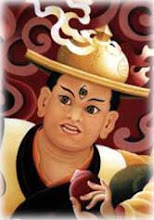
Sometimes in the midst of the detailed polemical discussion on the Internet of whether or not Dorje Shugden is a Buddha or a spirit, the fact that Shugden and non-Shugden practitioners lived together harmoniously and in mutual respect until the 1970s gets forgotten. These heated discussions are only taking place because the Dalai Lama publicly demoted Dorje Shugden, a Protector Buddha loved by his own teachers and thousands of other people. On the basis of his own high status as the unquestioned head of Tibetans and the most famous Buddhist in the world, the Dalai Lama's words have had the power to destroy the reputation of this Buddhist Deity and the great, revered masters who relied upon him.
These cruel, intolerant words are what have caused the severe schismatic problems now being faced by the Tibetan exile community and the bad reputation of previously respected Shugden practitioners around the world.
The words below are not those of a humble man, but of a man who knows full well the power he wields over his people.
The reasons he gives are based mainly on the provocative claim that Dorje Shugden is a Chinese spirit and thus a danger to the Dalai Lama’s life and health, a shibboleth that has never been backed up by any reasoning or evidence. When his words to the Tibetan people are examined, they show a depth of superstition quite out of keeping with the rational teachings of Lord Buddha.
To form a political decision and destroy religious freedom based on these reasons seems preposterous, and the resulting persecution is bewildering, a Buddhist witch hunt.
From the address delivered by the Dalai Lama at the preparatory session of Tamdrin Yangsang and Sangdrub empowerments, March 21 1996
"Since it happens according to government oracles that Dholgyal (Shugden) relates to Chinese Buddhist deities, we actually mentioned him by name in our exorcism based on Tamdrin at that time. Though these exorcisms cannot be relied upon, I have had strange dreams since then. Therefore I do not feel it will be comfortable for me to have worshippers of Shugden here. If acrimony between deities results in disharmony between humans, it will be spiritual ruination."
The Dalai Lama goes on to explain:
"This will affect the life span of the spiritual master as well".
He then points out and praises those former practitioners of Dorje Shugden, including "abbots and spiritual masters", who have given up and "become pure".
He explains how he knows that Dorje Shugden is a Chinese spirit based on locals' dreams:
"Others have reported of a bearded monk strangling them: this is very clear indication that Shugden is a Chinese spirit, far from being a deity."
To those who might not have given up the practice, he asks them to publicly make themselves known by standing up and leaving, rendering them pariahs with the words:
"Not only will it not benefit yourself but in the worst case may even become the cause of shortening the life of the Dalai Lama. If you wish the speedy death of the Dalai Lama, then I have no objection."
He explains that he has reached these conclusions through divination (throwing a dough ball):
"All final decisions have been concluded only through divination. This address too is a result of a divination this morning."
He ends with a threat, setting the scene for his followers to then take up the slander and persecution with impunity, which they have done:
"If you private monks and spiritual masters in the monastic colleges continue making excuses and continue worshipping thus, you shall have a day of regret... it will not be good if we have to knock on your doors."
A comment left on this blog also draws attention to the mixture of bribery and threats with which the Dalai Lama tries to make Trijang Choktrul give up his practice of Dorje Shugden, some of which we will repeat here. In their last meeting in Europe, in Graz, Austria, in 2003, the Dalai Lama stated:
“If you give up this deity, myself and all Tibetan people will appreciate it very much and our protector Nechung will take care of you and make you more successful and famous than ever. If you do not give up this deity, then your monastic career, like receiving the full monk’s ordination and taking Geshe examinations will not be possible. So I leave it to your judgement.”
For more of the Dalai Lama’s own words, see in the Dalai Lama's words.
Saturday, January 17, 2009
The Dalai Lama's Power Trip
Sunday, January 11, 2009
The Scapegoating of Dorje Shugden and Dorje Shugden Practitioners
In a recent letter, taking up many pages, Shugden (‘Dholgyal’) is once again blamed for Tibet’s religious and political problems:
Dharamshala, Edition 205, December 3, 2008
The warning that overpowers the dark side of the Three Realms, the self-voice of truth that reveals nakedly the self-embarrassment of the enemy who ambushes Tibetan religion and politics!
Written by some interested persons including Thupten Choepel
With our own eyes, we are observing a matter of life and death, where Tibetan religion and policies, including Tibetan nationals, are on the verge of extinction. This gloomy predicament has not occurred without a cause, nor was it simply due to the invasion by China. It is also not that there is lack of sufficient instruction from qualified gurus and deities, nor something that has taken place suddenly. This is a repercussion of negligence, backward, and many unfavorable conditions in many ways – the most serious of which is the Dholgyal issue… I view that China, Dholgyal, and Dholgyal society are equal in creating obstacles to Tibetan religion and politics.
Which brings us to a series of articles called "The Buddhist Witch", whose author has presented theory and research into how a witch-naming, scapegoating psychology has enabled the superstitious persecution of Dorje Shugden practitioners (induced by the actions of the Dalai Lama). Judging by the comments, people have found these articles thought-provoking, so we include some extracts here. If you are interested, please go to the original blog.
The Buddhist witch: Part one
... it is still apparent to me that there are enormous parallels between the naming and shaming of Shugdenites, particularly in India’s exiled Tibetan community, and the naming and shaming of so-called witchcraft practitioners all over the world.
The Buddhist witch: Part two
Well, let’s remove the Shugden scenario from its current political and religious context and examine it in stark academic terms. The fact is, once you’re familiar with examples of witch persecution around the world, the similarity with the kind of social ostracism and persecution that’s being visited on Shugden practitioners in the Exiled Tibetan Community in India, and indeed in the West too, becomes all too apparent.
Like ‘witches’, Shugdenites are accused of conducting harmful practices. In the language used, the nature of this harm is often vague, but it includes a general harm against other practitioners and against unwitting Shugden worshippers too. And just as with accusations against so-called ‘witches’, actual proof of this harm is rather scant. In fact, there is none. Not even the most ardent detractors of Shugden worship have been able to show any tangible evidence of the harmful and destructive nature of Shugden practice…
Like ordinary witchcraft trials the world over, no evidence has been needed to confirm the guilt of Shugden worshippers in perpetuating what is considered a harmful practice . With witch persecution, the effectiveness of the accusation has never depended on actual or reliable evidence. The same is the case here. For the most part, the claim of harmful practice against Shugdenites is reliant on hearsay and hypothesis, and the same would be true at any witch trial. It is given authority by numerous lamas, including the Dalai Lama, just as once inquisitors and sometimes even the Pope lent weight and authority to allegations of witchcraft and heresy…
And like those accused of being witches elsewhere, Shugdenites are currently being shunned within their communities. More than that, this ostracism is completely socially acceptable to most constituents of those communities.
The Buddhist witch: Part three
Witchcraft cannot be proven. Indeed, no proof is required. The success of any accusation relies entirely on whether or not the accusation can gain popular sanction. This is the basis of another theory: status degradation. If the accuser is able to convince the community that the person he or she has accused really is a witch, then he or she will have managed to reduce the status of that person in the eyes of everyone else. Moreover, they will have elevated their own status considerably….
I think it’s certainly pertinent that the Dalai Lama did not begin his campaign against Shugden in earnest until many of the most influential Shugden practitioners had died or had passed from influence….
It is an interesting fact that it’s taken over 10 years for Shugden to surface as a human rights issue within any degree of credibility. The impregnable reputation and status the Dalai Lama has enjoyed has ensured that the issue has never received popular sanction. And the vilification of proponents of Shugden has ensured that their case has not, until recently, been properly aired.
Moreover, as a consequence of the ban on Shugden, and the claims levelled against Shugden as a practice, lamas such as Trijang Rinpoche and Phabongka Rimpoche, who once enjoyed great status, are now discredited and even widely despised.
The Buddhist witch: Part four
The traitor within the gates: The underlying thesis of this theory is that, in the view of the persecutors, witches can be likened to traitors. It identifies the fact that, in social terms, witches are not generally viewed as an external threat. They are almost always people known to the accusers, and close to them. In truth, in most communities, the witches identified are usually neighbours, friends or family members – not strangers. So they are ‘within the gates’, operating within the confines of the community, part of the fold. And this makes the malicious acts attributed to them even more reprehensible. After all, there’s nothing more despicable than betrayal. And nothing inspires fear quite like the suspicion that someone close to you is out to get you.
Of course, the acts of treachery ascribed to witches are as invisible as they are harmful. And this makes the perceived breach of faith that much more acute….
…. In Dorje Shugden and his practitioners, Tibetans have been able to find the cause for a host of misfortunes that afflict them- from cattle disease to inexplicable deaths.
….. Tibet has found its scapegoats. And so has international Tibetan Buddhism.
The Buddhist witch: Part five
Where a cause to something is not evident, it is readily created. This is the real psychology behind witch naming. It is born from fear. And it is universal.
In many ways, the Yellow Book seems to be where much of the current conflict started. It’s a book of stories. Or, I should say, it’s a catalogue of misfortunes. The same sort of misfortunes I became familiar with in stories relating to witch naming in African, European, North American, Asian and Pacific accounts. Something bad happens, something supernatural is attributed as the cause. This is the pattern…
When you look at the stories above, there is nothing remarkable about the cause of death. These are ordinary deaths, by all accounts. Falling on a bicycle spoke is unfortunate, but it’s not unfathomable, and neither is it mysterious. Well, of course, neither is getting hit by lightning. Neither are any of the multitude of misfortunes generally attributed to witches….
How come these far-fetched accounts seem to have had such a big impact on the Dalai Lama, on lamas in other schools, and on ordinary Tibetans?
The Buddhist witch: Part six
“The danger of Dorje Shugden practice is that it can cause Buddhism to degenerate into a form of spirit worship.”
The above statement by the Dalai Lama was used to explain his stance on Dorje Shugden practice during the first demonstrations on the ban in the late 1990s. It is something he has reiterated several times in 2008 during the most recent demonstrations.
For those who are aware that the Dalai Lama himself is involved in various forms of spiritism, this has often been a source of tremendous bemusement. That involvement includes personally consulting the Nechung oracle on numerous issues, the nature of Dorje Shugden being just one of those issues…
The Buddhist witch: Conclusion
In Australia in 2008, when members of the Western Shugden Society protested against the Dalai Lama outside Sydney’s Olympic Park, a TV reporter asked a Tibetan supporter of the Dalai Lama what all the fuss was about. Her response was insightful. She said she didn’t really know much about the protesters, but she suspected they practiced some kind of Tibetan witchcraft. These were the words she used. They were in English. Nothing was lost in the translation.
In New York a month or two later, during the most dramatic moment of the protests by far, WSS demonstrators were surrounded by a highly energised and volatile crowd of Tibetan Dalai Lama supporters. I watched footage of the event online later. The most striking thing for me were the many Tibetan women waving their aprons at the protesters. This is a gesture Tibetans use to ward off spirits.
Of course, there was another common reaction that day. Many people waved money, or threw coins at the protesters, indicating that they had been bought off by the Chinese. In other words, they were treacherous. There were perfidious violators of trust. Like witches everywhere, they were traitors within the gates, and objects of utter contempt.
There is a great deal of evidence to support the points I’ve been making in this series - that supporters of Shugden are indeed the ‘witches’ of Tibetan Buddhism. They are the scapegoats of the Tibetan predicament. …
Ironically, China then is not the real problem. The real problem is Shugden. China’s invasion is just the natural consequence of the evil of Shugden worship. Though karma is invoked here, the parallel to accusations of witchcraft elsewhere couldn’t be clearer.
Sunday, September 14, 2008
Six important questions for the Dalai Lama or his supporters to answer
I found this comment on the new blog that officially goes with New Kadampa Truth ~ Fighting the Smears. If you have answers to these questions, please send your comments in and we will post them. This particularly applies to Tenzin Peljor!
Background
From Ron Cook: Below was an email sent to Tenzin Paljor, the most vehement critic of Shugden practitioners and of the NKT. He will not post it. He will not answer these questions nor other important ones. He is very selective about what he chooses to respond to. These are some of the most important questions concerning the Dalai Lama and yet they remain completely ignored. If you (Tenzin Paljor) are so confident in your beliefs, why are you afraid to answer these questions?
Dear Tenzin,
Since you have taken it upon yourself or been asked to represent the views of the Dalai Lama, I wish to submit six important questions that hopefully you can provide clear replies to. Since you have gone to great lengths to accommodate the questions of a concerned citizen in Brighton, then in fairness please show the same willingness to address the questions below - they too come from a concerned citizen. If you are as fair and open minded as the people visiting your blogs indicate, demonstrate these qualities by providing the appropriate answers. There is no valid reason not to post these questions and let your readers draw their own conclusions.
Sincerely,
Ron Cook
Six important questions for the Dalai Lama or his supporters to answer
1) If it is appropriate for the Dalai Lama to decide what spiritual practices are appropriate, and seeing clearly that such a decision causes divisiveness, why are the reasons he cites for the ban on Dorje Shugden not being supported by the teachings of Buddha? What Sutras specifically dictate the need for invoking spiritual bans? If the ban is not politically motivated there must be an authentic spiritual basis for this action. The teachings of Buddha address all possible delusions that sentient beings are capable of generating, therefore, please cite the Sutras that necessitate imposing the ban on Dorje Shugden.
2) Why is the Dalai Lama consistently patient, apologetic, and conciliatory toward the Chinese and not Dorje Shugden practitioners? The Dalai Lama has never acknowledged any email, petition, fax, phone call, telegram, or verbal request, nor has he ever granted an audience to anyone wishing to try and solve the Shugden controversy. However, he makes effort to engage the Chinese at virtually every opportunity. Please explain this double standard of engagement.
3) The Dalai Lama says that Dorje Shugden practitioners are free to ignore his ‘advice’ and continue to practice their faith. How is this possible when his government, his siblings, his personal friends, and representatives of Buddhist traditions that he controls, at every opportunity, disparage and attack Dorje Shugden practitioners? What basis is there to believe that Shugden practitioners have freedom? The Dalai Lama has said:
“Everyone who is affiliated with the Tibetan society of the Ganden Phodrang government, should relinquish ties with Dhogyal. This is necessary since it poses danger to the religious and temporal situation of Tibet. As for foreigners, it makes no difference to us if they walk with their feet up and their head down. We have taught Dharma to them, not they to us…
‘Until now you have a very good job on this issue. Hereafter also, continue this
policy in a clever way. We should do it in such a way to ensure that in future generations not even the name of Dhogyal is remembered.”
(From a speech delivered July 14th 1996, in Caux Switzerland)
Since the Dalai Lama has expressed an intention to utterly destroy the practice of Dorje Shugden, please explain the nature and type of freedom such practitioners shall enjoy.
4) Johan Candelin, director of the World Evangelical Fellowship’s (WEF) Religious Liberty Commission, invited the Dalai Lama to meeting in Helsinki on June 20, 1998. One of the topics discussed was the persecution of Christians in Sri Lanka by Buddhists. The Dalai Lama said that any Buddhist who persecutes Christians “misunderstands the true nature of Buddhism.” Persecution is defined in the Random House College Dictionary (def. 3) to mean:
“A program or campaign to exterminate, drive away, or subjugate a people because of their religious or moral beliefs or practices.”
If persecution of Christians is inappropriate and contrary to the true nature of Buddhism, why is the persecution of Shugden practitioners been not only acceptable, but advocated by the Dalai Lama? How can any reasonable person not consider the Dalai Lama’s words and actions to be hypocrisy in the extreme? Please clarify that persecuting Shugden practitioners is not hypocrisy.
5) The Dalai Lama freely admits that previous to his ban he was a practitioner of Dorje Shugden. He also composed a prayer to the deity entitled, Melody of the Unceasing Vajra, which is subtitled: ‘A Propitiation of Mighty Gyalchen Dorje Shugden, Protector of Conqueror Manjushri Tsongkhapa’s Teachings, by the Supreme Victor, the Great 14th Dalai Lama.’ Since the Dalai Lama is considered to be infallible and a fully enlightened being, how can these completely opposite beliefs be reconciled? Should we understand that the Dalai Lama was a faulty being when he practiced this deity in the past? If so, how is it that he can be considered to be faultless now? Enlightened beings cannot become more enlightened with time, nor can their perfect state degenerate. Moreover, such a pure being is omniscient, and would know indubitably that such a reversal of belief would cause tremendous confusion and problems. A flawless being should be able to provide a coherent, logical, and plausible explanation for this contradiction. The Dalai Lama has yet to provide such an explanation. Please explain how the Dalai Lama’s reversal on Dorje Shugden can be considered anything other than the confused and mistaken action of an ordinary being.
6) For nearly four centuries the deity Dorje Shugden has supposedly caused harm to many people. The Fourteenth Dalai Lama claims that since the time of the Fifth Dalai Lama, Dorje Shugden has caused not only a consistent degeneration of Buddhism, but many other serious problems. If this is true, why is it not possible for any of the reincarnations of the Dalai Lama to subdue this being? It is claimed that each of the Dalai Lamas are successive manifestations of the Buddha of Compassion (Chenrezig). There are many accounts of high Lamas subduing malevolent spirits in Tibet, yet the succession of ten Dalai Lamas cannot accomplish a similar feat. Practitioners of Dorje Shugden claim that he is an enlightened being, and therefore impossible to subdue. Please explain the failure of these ten Dalai Lamas to subdue Dorje Shugden. Please explain the failure of thousands of high Lamas to do the same.
Posted courtesy of Ron Cook.
Tuesday, August 5, 2008
Dalai Lama's Reasons for the Ban of Dorje Shugden
About the Dalai Lama’s Advice Concerning the Wisdom Buddha Dorje Shugden
The Dalai Lama has given three main reasons for banning the practice of Dorje Shugden. Before we reply to those, we should point out that although he says he “strongly discourages” it, there is an increasing body of evidence to show he has banned it. Witness the ID card – Tibetans are forced to swear that they will never venerate Dorje Shugden nor have any spiritual or material relationship with those who do or they will not be given an ID card (effectively making them refugees amongst refugees). The resulting ostracism and denial of basic human rights such as food, shelter and companionship has created great suffering in the Tibetan community and is clearly documented.
Even if the Dalai Lama’s views on the practice were reasonable or true, which they are not, it would still be unacceptable to force these views on others in this way, using his political power to impose his religious will. Imagine if any other leader forced this signature campaign on Muslims, or Jews, or Shamans? There would be a huge outcry and people would be reminded of Germany in the 1930s.
As for his reasons, they are refuted in detail by the words and experiences of thousands and thousands of practitioners past and present – for example, see www.WesternShugdenSociety.org and www.WisdomBuddhaDorjeShugden.org. In particular, look at the article Replies to the three reasons for the Dalai Lama’s ban on the practice of Dorje Shugden.
Here, we answer them briefly.
1.“The danger of Tibetan Buddhism degenerating into a form of spirit worship”. The practice of Dorje Shugden is not spirit worship because Dorje Shugden is viewed as the embodiment of Manjushri, the Buddha of Wisdom, arisen in this form to protect Buddha’s teachings. All Wisdom Buddha Dorje Shugden practitioners, including the Dalai Lama’s teachers and millions of Gelugpa Lamas and practitioners of past generations, are actual Buddhists who practice the complete Dharma of Buddha Shakyamuni. It is untrue, patronizing and insulting to say that they are not. It would also mean that the teachings that the Dalai Lama himself is giving are non-Buddhist as these come from his teachers who were Dorje Shugden practitioners.
2. “Obstacles to the emergence of genuine non-sectarianism”. The Dalai Lama allegedly promotes interreligious understanding and harmony, just so long as Dorje Shugden practitioners can be the exception to the rule. Even today, for example, everyone can attend the “formal religious teachings” by the Dalai Lama – come along if you are a Muslim, a Catholic, or an actual spirit worshipper, everyone is welcome! But a Buddhist Dorje Shugden practitioner? You will be asked to leave. That the Dalai Lama says he is a man of peace and tolerance makes this Buddhist apartheid even more intolerable. There is absolutely no evidence to support the claim that it is Wisdom Buddha Dorje Shugden practitioners who promote sectarianism; they are simply asking for the freedom to practice their ancient tradition without being persecuted and shunned. The Dalai Lama hides behind his celebrity status and blames the victim for the crime.
3. “Especially inappropriate in relation to the well-being of Tibetan society”. Imagine if President Bush were to declare that someone’s spiritual practice was affecting his life and ability to govern and so it should be stopped? He would be considered dictatorial and idiotic. The idea that those who do their peaceful prayers to Wisdom Buddha Dorje Shugden for the protection of positive minds of compassion and wisdom is somehow detrimental to the government headed by the Dalai Lama and therefore should be stopped is likewise dictatorial and embarrassingly superstitious. The Dalai Lama is now 73 years old, in fine health, and he gave up the idea of Tibetan independence years ago. Scapegoating Dorje Shugden practitioners for the failure to win a free Tibet is a political ploy and, if it were not the popular charismatic Dalai Lama who was saying these things, this would have been laughed out of court a long time ago. It is not Wisdom Buddha Dorje Shugden practitioners who are destroying Tibetan unity, it is the Dalai Lama’s controversial and divisive actions of splitting families and communities down the middle.
The Dalai Lama has urged people to consider this and “to act accordingly”. We are confident that if you do take the time to critically examine his reasons and do some research, you will agree that they make no sense and that, even if they did, he has no right to impose these religious views on others through political processes such as the ID card.
Why would so many Tibetan and Western practitioners take all this time and expense to travel to demonstrate against one of the world’s most famous religious leaders if there were not some very urgent and compelling reason for doing so? We are here because there is a major problem in Tibetan exile society and it is just going to get worse if we do not have the courage to point it out.
For 30 years, Lamas and practitioners have tried to communicate with the Dalai Lama on this subject, and for 30 years he has either ignored or insulted us.
To say we are demonstrating because we are being paid by the Chinese is a lazy and laughable excuse – firstly because there is not a shred of evidence for this because it is not remotely true; and secondly because why would employed, educated and free citizens need Chinese money to make their voices heard?